

SOS Radio Week supports the work of the many independent lifeboat stations and coastal rescue organisations that provide vital services in areas not covered by RNLI lifeboats.
Independent lifeboat stations and coastal rescue organisations pre-date the formation of the RNLI, yet these equally brave and professional volunteers don’t always get the recognition they deserve because they are not part of the recognised national organisation.
However, in 2022 the National Independent Lifeboat Association (NILA) was formed to give such organisations a collective voice and to help raise awareness of them; not just to the public, but also to government and other groups that might be sources of much needed funding.
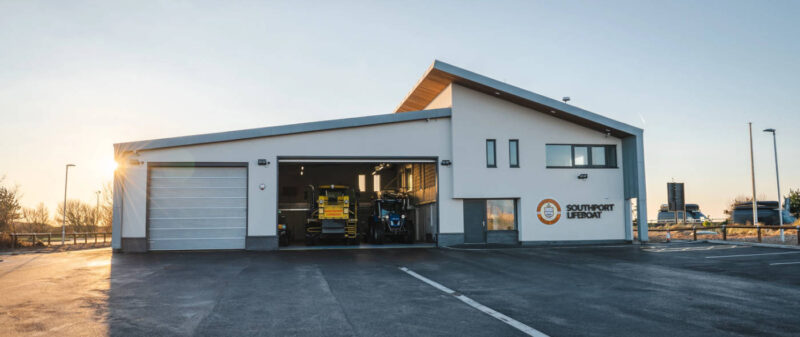
To give you an example of the level of commitment these independent lifeboat stations and rescue organisations have, the Southport Offshore Rescue Trust (who’s Southport Lifeboat Station is pictured above) …
- Can trace their history back to when they were part of the RNLI and their crew was lost in the Mexico disaster of 1886.
- Opened a brand new purpose-built £1.4m lifeboat station in 2022.
- Operate Arctic 24 and Class D lifeboats.
- Possesses two tractors for launching; a marinised Caterpillar Challenger and a more traditional New Holland.
- Run two all-terrain quad bikes and a number of state-of-the-art unmanned aircraft systems (UAS).
- Run their own charity shop.
Another origination that demonstrates the level of commitment to saving lives around the coast of the British Isles is Bay Search & Rescue. Established in 1999, this team watch over the users of the treacherous Morecambe Bay sands, scene of the dreadful Morecambe Bay Cockling Disaster in 2004. They operate a fleet of Hagglund ATERV (All Terrain Emergency Rescue Vehicles) personnel carrier/ambulances and a cargo carrier with a crane. They are also in the forefront of innovation, building the UK’s first airboat to be used for coastal search and rescue. All of this equipment is essential, as much of Bay Rescue’s work is done on the expansive mud-flats that are no lover of anything living that strays on to them. However, they can also be found further inland assisting during events like the Cockermouth floods of 2009.